
Today, the Voluntary Separation Incentive Payment (VSIP) and Voluntary Early Retirement Authority (VERA) programs are used to manage workforce restructuring. These programs are authorized under current federal regulations. You are only eligible for a VERA if your agency offers you a VERA; you cannot be facing removal for misconduct. Surprisingly, these two offers can be combined; if you qualify for both VERA and VSIP and are offered both, you can take the early retirement (VERA) and receive the VSIP separation-incentive in pay.
The government (like private-sector employers) chooses to downsize from time to time. If you are offered a VERA or VSIP, choosing a voluntary departure allows you to maintain some control over your exit rather than being forced out through an involuntary separation. These offers contain provisions to maintain some benefits, which is also a worthy consideration during downsizing.
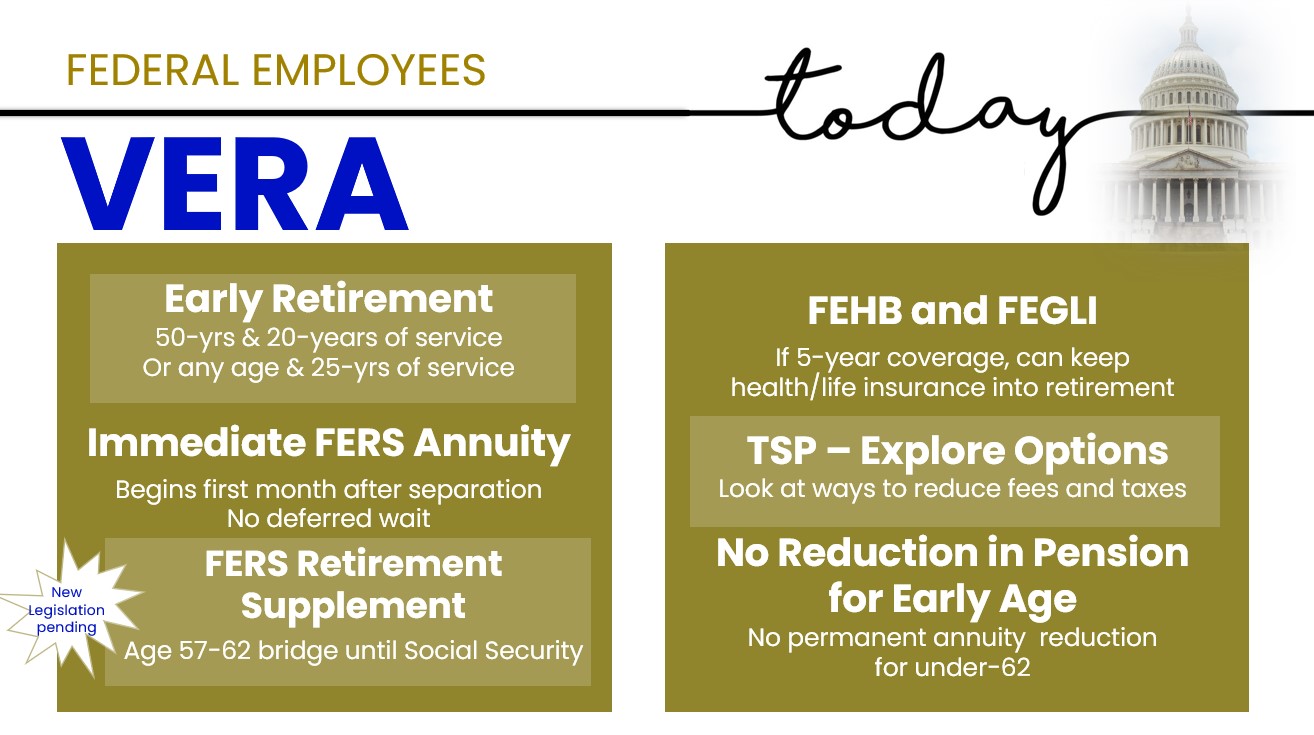
VERA (Early Retirement)
If you’re offered a VERA and are willing to retire early (before your standard eligibility age and service requirements) this could be a very beneficial move. Under this program, you would become an annuitant, receiving an immediate annuity.
To qualify for a VERA, you must have at least 50-years old and have 20-years of Federal service, or be any age with 25-or-more-years of service. You must currently be covered by either FERS or CSRS, and your agency must currently be involved in downsizing or restructuring.
There is no restriction on accepting another position as a federal employee.
VSIP (Buyout)
If you’re not retirement-eligible, are in a position to leave and find other employment and would like a financial offset (up to $25,000 before taxes) while you look for work, a VSIP (which encourages voluntary separation through retirement or resignation) may be for you.
To qualify for a VSIP, your position must be in line for elimination. You cannot be eligible for immediate retirement (except under a VERA, which can be combined with a VSIP offer), generally must have been employed for at least 3-years, cannot have accepted a prior VSIP. If you work in a categorized, critical position, or are facing involuntary separation due to performance issues, you may not be eligible to receive a VSIP offer.
You will forfeit your ongoing retirement annuity when you accept a VSIP, unless it’s combined with VERA. If, at a later date (within the next 5-years), you are re-employed by the Federal Government, you will be responsible for repaying the full amount of the VSIP/buyout.

Right now, My Federal Benefits and the Experts at Federal Solutions Support are working daily with Federal Employees who have been offered a VERA or VSIP letters. They take calls from Federal Employees wondering whether they’ve been offered one of these incentives; because they’ve heard that their agency is issuing these severance agreements.
Our best advice is, “If it’s not in writing it doesn’t exist.”
If you have received a written letter, on your agency’s letterhead, then you have a legitimate offer to consider, and we’re glad to have one of our Experts provide a complimentary consult to every Federal Employee who’s weighing whether their individual offer is right for them.
Talk with your friends and family. Then, call us and get a set of experienced eyes on your offer.
Health Care in Retirement
Keeping your Health and Life Insurance is possible. Sometimes it’s worth the cost, sometimes it’s not. You can keep health (FEHB) and life insurance (FEGLI) at the time you accept a VERA/VSIP or begin retirement only if you’ve been enrolled for at least 5-years before retiring or taking a VERA/VSIP.
To keep your existing Health Benefits going at the time of separation from Federal Employment, you can sign-up for COBRA (Consolidated Omnibus Budget Reconciliation Act). While you’re employed, the Federal Government (through FEHB) normally covers about 70-75% of the total premium. With COBRA, you will pay the full premium (both employee & government portions) plus a 2% administrative fee. You’ll have 60-days to enroll in COBRA and can keep the coverage for up to 18-months after separation.
- If you’re under 65 (and not qualified for Social Security Disability Insurance/which comes with a 24-month waiting period), then you’re not yet eligible for Medicare. You’ll need COBRA; especially if you or a family member is managing a major health condition, then the added cost of COBRA may be worth the continuity of care. More affordable than COBRA is a policy through the Affordable Care Act/ACA Marketplace insurance. And, another option includes being added to a spouse’s insurance plan, as this is a qualifying “Life Event.”
- If you’re 65 or older, consider enrolling in Medicare when you retire under VERA. You’ll want to consider both Medicare Part A (hospital coverage), Part B (medical coverage), and perhaps an Advantage Plan which covers parts A, B, and D (prescription drugs); often reducing overall costs with in-network commitments. To get advice on your individual situation, our team provides a no-cost Health Plan consult with a Federal Health Benefits Expert with over 30 years of experience and knowledge.
If you keep FEHB in retirement, Medicare will become your primary insurer, with FEHB as the secondary. Another option is to keep Medicare Part A (free if you paid Medicare taxes) and delay Part B (in 2024, Part B costs were about $175/month).
Life Insurance in Retirement
Your life insurance coverage will stop (including Accidental Death and Dismemberment insurance). Although you may be eligible to continue coverage as an annuitant (retiree) or while in receipt of workers’ compensation benefits, it is generally recommended that you pursue another policy (unless you are no longer insurable due to health concerns).
At the end of the last pay period in which your agency withheld life insurance premiums from your pay, if it determines that your pay will be insufficient to cover the withholdings for the next six months or more, and you decide that you do not want to pay these premiums directly, this particular life insurance policy will come to an end.
Although life insurance is an essential part of any financial strategy, providing peace of mind by helping protect the security of your most important people and values – it can be easy to say yes to solutions advertised as, “easy.” Know that these come with strings. Talk to a Federal Employee Expert to put in place a plan that works for you today and tomorrow, without hidden-stipulations or policies that make you insurable today but not tomorrow.
VSIP (Buyout)
If you’re not retirement-eligible, are in a position to leave and find other employment and would like a financial offset (up to $25,000 before taxes) while you look for work, a VSIP (which encourages voluntary separation through retirement or resignation) may be for you.
To qualify for a VSIP, your position must be in line for elimination. You cannot be eligible for immediate retirement (except under a VERA, which can be combined with a VSIP offer), generally must have been employed for at least 3-years, cannot have accepted a prior VSIP. If you work in a categorized, critical position, or are facing involuntary separation due to performance issues, you may not be eligible to receive a VSIP offer.
You will forfeit your ongoing retirement annuity when you accept a VSIP, unless it’s combined with VERA. If, at a later date (within the next 5-years), you are re-employed by the Federal Government, you will be responsible for repaying the full amount of the VSIP/buyout.
From CEO Eric Steffy
“We’re seeing a lot of people 55-65 who are being presented with an offer that would allow them to leave Federal Employment early – and still take their Federal Benefits. When we read through those documents, we often find that they will have a 2-year gap before one of their benefits kick-in, namely their FERS-supplement. At that point, we plan for how to cover costs in the intervening two years until they become eligible for their full benefits. Every agency is implementing severance plans according to their governing rules and payment formulas. So, never presume that what someone else is offered, in their position, is what you’ll be offered.
Every situation is unique, so read your documents – and by all means – get a second set of experienced eyes to read them with you. Whether employees stay at the Federal government or leave, they need a truthful plan that will keep them safe.”
VERA Basics – What You Need to Know
- Retirement: A Voluntary Early Retirement Authority (VERA) allows eligible federal employees to retire early during workforce reductions, restructuring, or reorganization; with full benefits, prior to meeting standard age and service requirements.
- Age Requirement: A VERA works by lowering age and service requirements so that you can retire now, with full benefits, if you’re at least 50-years old with 20-years of service, or you have 25-years of service (regardless of age). For instance, a 45-year-old can qualify for a VERA if they meet the minimum service requirements (which is 25-years of experience if under age 50). Their agency must be offering VERAs as part of a workforce reduction or restructuring plan. If you accept the offered VERA, you will receive an immediate pension but would not receive the FERS Supplement until you are 60-years old.
- FERS: If you take a VERA, you’ll begin receiving your full FERS pension at the moment stated in your offer (immediately, without a deferred waiting period). And, while you will get your full pension, you should know that your pension is based on your High-3 salary and years of service, so an earlier retirement will mean fewer service years contributing to your pension.
- FERS Supplement: You may qualify for the FERS Supplement, if you’re under age 62, which provides additional income until Social Security kicks in. Read more about the FERS Supplement. When considering a buyout offer, like a VERA or VSIP, you should take into account possible reductions in unemployment compensation, whether you want to pay for COBRA (health benefits) or look for other coverage, and whether you are eligible for immediate retirement or whether their can defer or postpone your retirement until you are of age. Lastly, you should consider whether you may want to return to Federal Employment, as some severance agreements restrict returning to Federal service, for a time (your annuity will likely be reduced or paused during time away from Federal service).
VERA – Special Provisions
Federal employees such as Law Enforcement Officers (LEOs), Firefighters, Air Traffic Controllers, and few others qualify for the FERS Supplement under special provision rules. These VERA’d employees can retire earlier and still receive supplements due to the nature of their work. They do not have to wait until their MRA if they retire with a full retirement. They simply need to have 25-years of service (no minimum age) or have 20-years of service and be at least 50-years old.